You're not getting bites
You don't know whether to change your location, your bait or your presentation, so you change all three and learn nothing.
INTRODUCTORY OFFER: Get The Weekend Angler's Survival Guide for $27 (regularly $37) See What's Included
The Weekend Angler's Survival GuideThe Weekend Angler's Guide $27
Get My Fishing GuideGet the GuideFrom Fishing With Mike
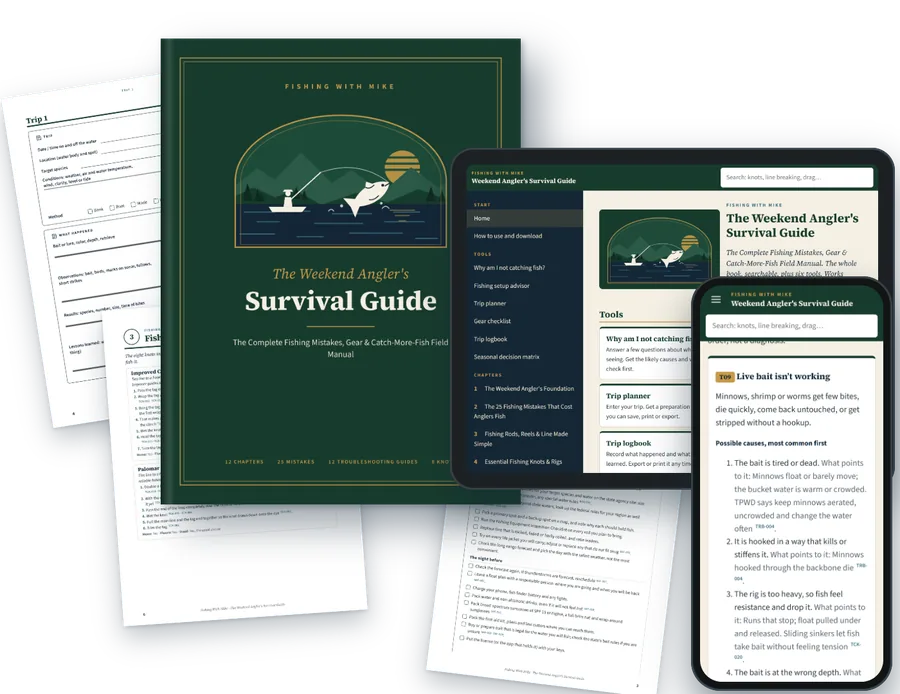
The practical fishing field guide that helps you avoid common mistakes, choose better gear, and know what to try when the fish aren't biting.
One-time purchase • Digital download • No subscription
You get your gear ready, head out to your favorite spot, cast for hours... and sometimes nothing happens.
So you change your lure. Then your location. Then your bait.
But what if the real problem isn't your equipment? What if there's something simple you've been overlooking?
You don't know whether to change your location, your bait or your presentation, so you change all three and learn nothing.
You wonder whether the problem is the drag, the hook, the line, the knot or the way you fight the fish.
The tackle box gets heavier, and you're still not sure which purchases actually solved anything.
You want a straightforward way to decide what to try next, instead of hoping the next cast is different.
That's exactly why The Weekend Angler's Survival Guide was created.
One practical reference system for better fishing preparation, smarter gear choices, and fewer avoidable mistakes.
Know which common issues to investigate when your fishing isn't going as planned, in a sensible order.
Recognize the 25 equipment and technique mistakes that cost anglers fish, before they become habits.
Rods, reels, line and tackle explained without the jargon, and a scorecard for deciding what's worth buying.
What to look for in a lake, a river or a tidal bay, and a 15-minute routine for reading new water.
Checklists for the night before, the boat ramp and the water, so the important things don't get left in the garage.
Read it cover to cover, or jump straight to the answer you need. Every chapter starts with a one-page Quick Answer.
All of it is included in your purchase. Tap any page to see it up close.
Included · 1 of 8
The heart of the bundle: a 267-page illustrated manual in 12 chapters, in full color and in a printer-friendly edition.
Included · 2 of 8
Chapter 2: the 25 mistakes that cost anglers fish, each with the same six parts.
Included · 3 of 8
8 knots with original step-by-step diagrams and 6 rigs, plus a one-page knot quick-reference sheet to print.
Included · 4 of 8
A decision system for choosing bait and lures from the conditions, with 12 bait and lure cards and a printable cheat sheet.
Included · 5 of 8
12 troubleshooting entries, from "fish won't bite" to "the fish finder makes no sense", in the book and as a guided question tool in the interactive guide.
Included · 6 of 8
Plan the trip, pack with a checklist, then record what happened: a 45-page printable logbook plus a trip planner and digital logbook in the interactive guide.
Included · 7 of 8
Chapter 8 for small-boat anglers: positioning, anchoring, drift fishing, safety around structure, and reading a fish finder.
Included · 8 of 8
Four weekly phases with one practical assignment a day, built for anglers who can only fish on weekends.
Also included
20 quick-reference cards to print, four to a page; the 15-sheet Field Toolkit of checklists, charts and worksheets; and a START HERE sheet that explains every file.
These are real excerpts from the guide, word for word. The small codes like TCK-013 are citations: every fact in the book is checked against a published source.
From Chapter 2 · Main manual, page 29
Mike's Quick Check If I were the fish I want, what would I be getting from this exact spot?
The full entry also covers when this advice changes. 24 more mistakes follow it in the book.
From Chapter 4 · Main manual, page 83
Ties line to a hook, swivel or small lure with a doubled strand. Animated Knots calls it one of the strongest and most reliable fishing knots TCK-001, and TPWD calls it the easiest to tie TCK-011.
From the Bait & Lure Selection Cheat Sheet · Main manual, page 119 (first 5 of 12 rows)
| Bait or lure | Depth | Often strong when | Often weaker when |
|---|---|---|---|
| Worms and night crawlersLive bait | Any depth. Under a bobber for shallow or suspended fish, or on a sinker rig for fish feeding on the bottom. |
|
|
| Live minnows and baitfishLive bait | Suspended at a chosen depth under a slip bobber TCK-026, or near the bottom on a sliding-sinker rig, which lets a fish take the bait without feeling tension TCK-020. |
|
|
| Live shrimpLive bait | Under a popping cork, which holds the bait at a set depth, or on the bottom on a sliding-sinker rig with just enough weight to hold in the current TCK-024TCK-058. |
|
|
| Crickets and grasshoppersLive bait | Shallow. Usually under a small float, just off the bottom or at the depth fish are holding. |
|
|
| Cut bait and prepared baitsLive bait | On or near the bottom. Catfish search for food near the bottom, so you need weight to keep the bait down TCK-017. |
|
|
From Chapter 10 · Main manual, page 215 · also in the interactive guide's question tool
Fish are hooked solidly for a while, then the hook pulls free mid-fight or at the boat, without the line breaking.
The full entry continues with corrective actions, what to try next, and when to stop or get help.
From the Field Toolkit and Chapter 1 · try it: the boxes tick
Three passes: one a week out, one the night before, one when you arrive. Each item is something you do, not something you think about. Rules change, so the legal items send you to the agency, not to memory.
The printable checklist continues with the at-the-water section. 14 more sheets come with it.
The guide is built around one habit: change one thing at a time, for a reason, and write down what happened.
Use the guide to narrow down what may be going wrong: no bites, short strikes, lost fish, tangles.
Review your setup, location, conditions and presentation, in the order the guide gives.
Choose one appropriate change rather than guessing at five.
Use the logbook to record what you saw and what worked, so the next trip starts smarter.
An example of the process, not a promise of results.
There's plenty of good fishing advice out there. The hard part is finding the right piece again when you need it, and knowing when it applies.
| Random fishing advice online | The Weekend Angler's Survival Guide |
|---|---|
| Scattered across different videos | Organized in one reference |
| Difficult to find again | Searchable digital guide |
| Advice may lack context | Explains when techniques apply, and when they don't |
| Easy to forget details | Printable reference sheets and pocket cards |
| No consistent learning framework | A structured 30-day improvement plan |
| Requires repeated browsing | Downloadable files for offline use |

Meet Mike
I'm Mike, and Fishing With Mike is a channel about the practical side of fishing: the common mistakes that cost fish, the gear decisions that actually matter, and the old-school methods that are still worth knowing.
This guide is the channel's field manual. It takes the questions that come up again and again and puts the answers in one place, in plain English, with a checklist or a chart wherever one helps. It doesn't pretend fishing is simple, and it doesn't promise you a full cooler. It does tell you what to check, what to change and when the advice depends on the fish you're after.
Every fact in it that you could look up, from life jacket rules to how a fish finder draws an arch, was checked against a published source, and the sources are listed at the back.
My goal is simple: help you spend less time guessing and more time enjoying your fishing trips.
Three common situations, and what the guide has you look at first.
Example A
Problem: Fish are repeatedly getting away.
What the guide has you inspect, in order:
From troubleshooting entry T03 and the mistakes chapter.
Example B
Problem: Fishing activity is consistently slow.
What to evaluate, in the order the Fishing Success Framework uses:
From Chapter 1 and troubleshooting entry T08, The spot seems dead.
Example C
Problem: An angler thinks an expensive new reel will fix what is really a technique problem.
The guide's Gear Value Scorecard asks seven questions before you spend:
One of its worked examples, a high-end fish finder upgrade for a small-lake bank angler, scores 11 out of 35. Skip it for now.
From Chapter 9, main manual, page 204.
Everything you need to learn the fundamentals, troubleshoot common mistakes, and make smarter fishing decisions, all organized in one convenient digital bundle.
Edition 1.0, October 2026 · digital download
Regular price $37 Introductory price $27
Introductory price. The regular price is $37.
One-time payment. Digital delivery. No monthly fees.
Payment is handled by Gumroad. We never see your card details.
30-day money-back guarantee. If the guide isn't what you expected, reply to your purchase receipt within 30 days of buying for a full refund.
Refund Policy · Terms of Purchase · Privacy Policy · Contact & Support
Yes. It starts from the fundamentals in plain language: how fish relate to temperature, cover and food, how to choose a rod, reel and line, and how to tie the knots you need. Every chapter opens with a one-page Quick Answer, so you can start there.
Most experienced anglers use it as a reference: the 12 troubleshooting entries, the bait and lure decision chart, the knot and rig reference, the gear scorecard and the checklists. Each mistake also says when the advice changes for different species, gear or water.
The main emphasis is recreational freshwater fishing: lakes, reservoirs, rivers and ponds. It also covers inshore saltwater (tides, red drum, speckled trout, flounder, popping-cork and Carolina rigs) and small-boat fishing. It does not cover offshore or fly fishing.
No. It is a downloadable digital product: PDF files and an interactive web guide. Nothing is shipped.
Yes. There is a printer-friendly edition of the manual on white pages, plus the 15-sheet Field Toolkit, the trip logbook and the pocket cards, all on US Letter paper and readable in black and white.
Yes. The PDFs open on any phone or tablet with a PDF reader, and they are fully searchable. The interactive field guide is a small web app that runs in your browser: it works best on a computer or tablet, and on phones whose browser can open downloaded web files. START HERE explains each option.
Only to download your files. After that the PDFs work offline, and the interactive guide works offline too once you have unzipped it. It never sends anything anywhere; trip plans and log entries stay on your own device.
No. A whole chapter is about not buying what you don't need: what is essential, what is optional, when budget gear is enough, and a scorecard to test a purchase before you make it.
No. Fishing results depend on many things, including the species, the water, the season, the weather, your skill and local regulations. The guide helps you prepare better, avoid common mistakes and make better decisions on the water.
After checkout, Gumroad gives you a download page and emails you a receipt with the same download link. You get one package with everything in it, and START HERE explains each file.
Yes. $27 once. There is no subscription and nothing renews.
Reply to your purchase receipt email, which comes from the checkout provider, and we'll help.
30-day money-back guarantee. If the guide isn't what you expected, reply to your purchase receipt within 30 days of buying for a full refund. Read the full refund policy.
This is Edition 1.0, October 2026. The edition and date are on the title page of every file, and corrections are listed in the book's Review Status page. No future editions are promised.
You don't need to know everything about fishing. But having a practical guide to help you avoid common mistakes, prepare your gear, and decide what to try next can make every trip more rewarding.
Get the Complete Guide — $27Digital download • Printable resources • One-time purchase
Spend less time guessing. Spend more time fishing.